🗓️ What Is Panchang? Uses and Importance in Vedic Astrology
In Vedic astrology, timing is not understood only by clock, calendar date, or weekday. Traditional Indian timekeeping goes much deeper. It studies the quality of time, the movement of the Moon, the relationship between Sun and Moon, nakshatra, tithi, yoga, karana, sunrise, sunset, and planetary influence. This complete system is called Panchang.
Panchang is one of the most important tools in Vedic astrology. It helps in selecting the right time for important activities, understanding daily energy, observing festivals, planning rituals, checking auspicious and inauspicious periods, and aligning human action with cosmic rhythm.
At Karmiktantra, we see Panchang as a guide to conscious living. It is not meant to create fear around every minute of life. It is meant to help people understand time with more awareness. Just as a farmer studies season before sowing seeds, a person can study Panchang before beginning important work.
Panchang does not replace effort.
Panchang supports right timing.
🌌 What Is Panchang?
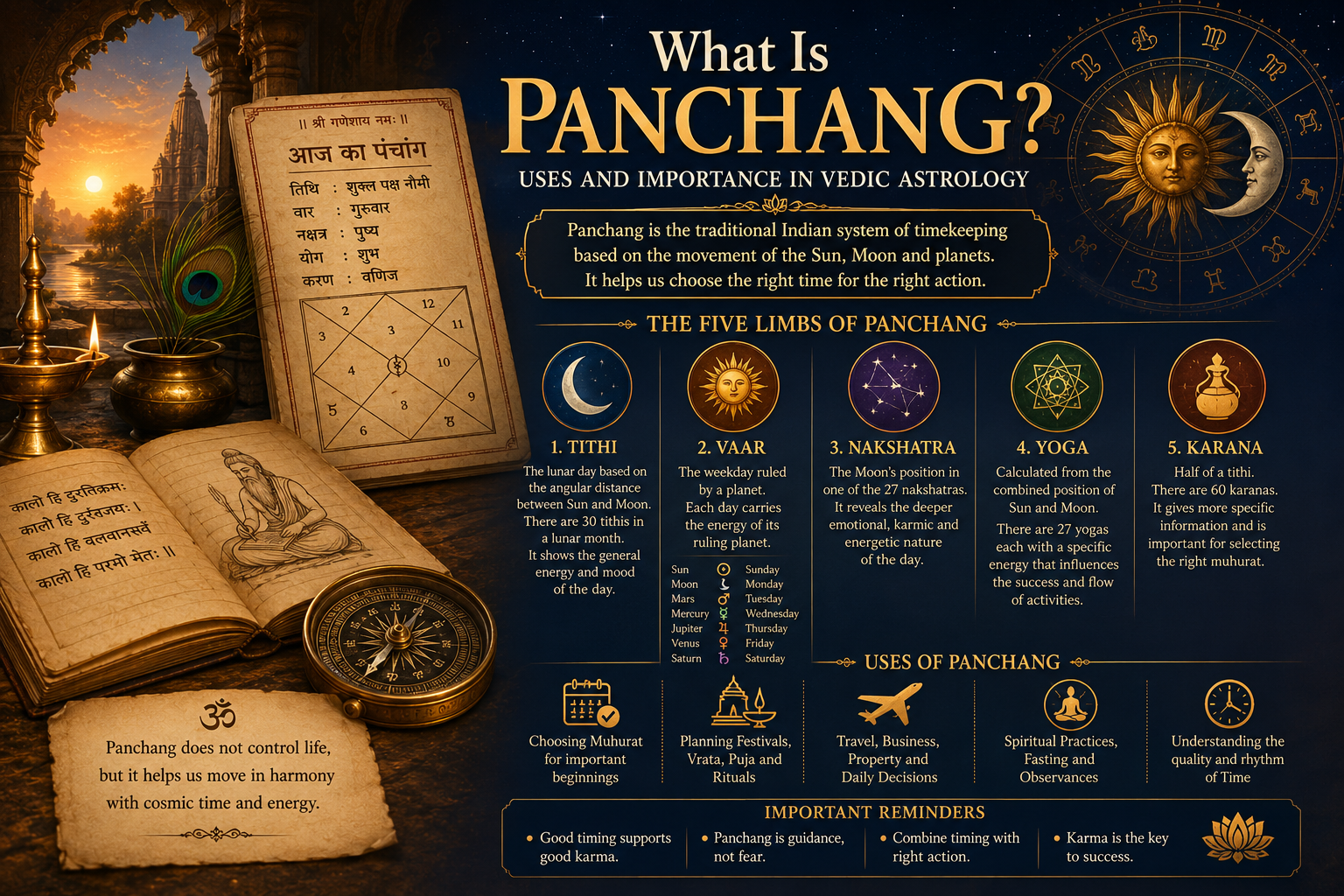
The word Panchang comes from two Sanskrit words: Pancha, meaning five, and Anga, meaning limbs or parts. So Panchang means “five limbs of time.” These five limbs are:
Tithi
Vaar
Nakshatra
Yoga
Karana
Together, these five elements describe the quality of a particular day. A normal calendar tells us the date. Panchang tells us the nature of that date.
For example, two days may both be Mondays, but their tithi, nakshatra, yoga, and karana may be different. That means the energy and suitability of the day may also be different.
This is why Panchang is used for muhurat, festivals, vrata, puja, marriage, griha pravesh, business opening, travel, religious observance, and many traditional decisions.
🪔 The First Limb: Tithi
Tithi is based on the angular distance between the Sun and the Moon. In simple words, it is a lunar date. There are 30 tithis in one lunar month: 15 in Shukla Paksha and 15 in Krishna Paksha.
Shukla Paksha is the waxing phase of the Moon, when the Moon grows from Amavasya toward Purnima. This phase is generally connected with growth, expansion, visibility, and increase.
Krishna Paksha is the waning phase of the Moon, when the Moon decreases from Purnima toward Amavasya. This phase is often connected with release, inwardness, completion, detachment, and spiritual reflection.
Tithi is very important because it shows the emotional and energetic quality of the day. Certain tithis are considered suitable for specific works, while some are avoided for major auspicious beginnings.
For example, Purnima is often connected with fullness, devotion, worship, and spiritual practices. Amavasya is connected with ancestors, inner silence, endings, and karmic reflection. Ekadashi is widely observed for fasting, discipline, devotion, and purification.
A person who understands tithi begins to see time as a living rhythm, not just a number on a calendar.
🌞 The Second Limb: Vaar
Vaar means weekday. In Panchang, each weekday is ruled by a planet. This gives every day a planetary quality.
Sunday is ruled by Sun.
Monday is ruled by Moon.
Tuesday is ruled by Mars.
Wednesday is ruled by Mercury.
Thursday is ruled by Jupiter.
Friday is ruled by Venus.
Saturday is ruled by Saturn.
Each day carries the nature of its ruling planet. For example, Sunday is connected with authority, confidence, fatherly energy, and soul power. Monday is connected with mind, emotion, water, motherly energy, and calmness. Tuesday is connected with courage, action, energy, and conflict. Thursday is connected with guru, wisdom, dharma, learning, and blessings. Saturday is connected with karma, discipline, service, delay, and responsibility.
This does not mean one day is always good and another day is always bad. It means each day has a certain planetary flavor. When work is aligned with the nature of the day, it may feel more harmonious.
For example, spiritual learning on Thursday, disciplined work on Saturday, communication or business planning on Wednesday, beauty or relationship-related work on Friday, and courage-based action on Tuesday may feel naturally connected.
🌙 The Third Limb: Nakshatra
Nakshatra is one of the most important parts of Vedic astrology. The zodiac is divided into 27 nakshatras, and the Moon moves through one nakshatra at a time. The nakshatra of the day shows the deeper emotional, karmic, and energetic field active at that time.
Each nakshatra has its own symbol, deity, nature, power, and psychological quality. Some nakshatras are soft, some are sharp, some are movable, some are fixed, some are fierce, some are spiritual, and some are creative.
This is why nakshatra is extremely important in muhurat. A suitable nakshatra can support the nature of the work being started.
For example, some nakshatras may be better for learning, healing, marriage, travel, business, property, spiritual practice, or creative work. Some may be avoided for delicate beginnings because their nature may be too sharp, unstable, or intense.
Nakshatra also helps us understand the mood of the day. Some days feel emotional. Some feel restless. Some feel productive. Some feel heavy. Some feel spiritual. Nakshatra is one reason behind this subtle difference.
🧘 The Fourth Limb: Yoga
Yoga in Panchang is not the same as physical yoga postures. Here, Yoga is calculated from the combined position of the Sun and Moon. There are 27 yogas in Panchang, and each yoga has a specific quality.
Yoga shows the combined energetic condition of the day. It can influence the success, mood, flow, and nature of activities. Some yogas are considered auspicious and supportive, while others may be more challenging or require caution.
A good yoga can support clarity, success, harmony, and growth. A difficult yoga may indicate obstacles, confusion, pressure, or instability. But again, Panchang should not be used to create panic. It should be used to understand the nature of time and act wisely.
If the yoga of the day is not very supportive, it does not mean the whole day is useless. It means major beginnings may require more care, and spiritual practices or simple routine work may be better.
🔱 The Fifth Limb: Karana
Karana is half of a tithi. Since there are 30 tithis in a lunar month, there are 60 karanas. Karana is used especially for muhurat and daily activity selection. It gives more detailed information about the practical nature of time.
Some karanas are considered favorable for work, movement, business, or activity. Some are considered less suitable for auspicious beginnings. Karana helps refine the timing of action.
If tithi is the larger lunar mood, karana is like a smaller operational quality inside that mood. It helps astrologers select a more suitable time for specific purposes.
This is why serious muhurat selection does not depend only on one factor. Tithi, vaar, nakshatra, yoga, karana, lagna, planetary strength, rahu kaal, and other factors are studied together.
🛕 Panchang and Muhurat
One of the most important uses of Panchang is choosing muhurat. Muhurat means an auspicious time chosen for beginning an important activity. In Indian tradition, people check muhurat for marriage, engagement, griha pravesh, business opening, naming ceremony, vehicle purchase, property registration, travel, puja, and many sacred activities.
The idea behind muhurat is simple: when you begin something at a supportive time, the beginning receives better energetic alignment.
This does not mean muhurat alone guarantees success. If a person starts a business at a good muhurat but has no planning, no product, no discipline, and no customer understanding, the business may still fail. Muhurat supports karma, but it cannot replace karma.
A good time helps. Right action completes the result.
🌿 Panchang in Daily Life
Panchang is not only for big rituals. It can also help in daily awareness. A person can use Panchang to understand the general energy of the day, choose a good time for important calls, plan spiritual practices, observe fasting days, understand festival timing, or avoid unnecessary risk during sensitive periods.
For example, someone may use Panchang to check Ekadashi for fasting, Amavasya for ancestor-related practices, Purnima for spiritual worship, Thursday for guru-related work, or Saturday for service and discipline.
Panchang can also help a person become more connected with nature. Modern life has made us mechanical. We follow clock time but forget lunar time, seasonal rhythm, and spiritual timing. Panchang reminds us that time is not dead. Time has quality.
🔥 Rahu Kaal, Yamaganda and Gulika
Many Panchang systems also show periods such as Rahu Kaal, Yamaganda, and Gulika. These are time periods traditionally avoided for starting major auspicious activities.
Rahu Kaal is especially known and widely checked before beginning important work. It does not mean normal daily work must stop completely. People still eat, travel, work, and live during Rahu Kaal. But for a new sacred or important beginning, many prefer to avoid it.
This is where balance is needed. Panchang should not make life fearful. It should make decisions thoughtful. If something urgent must be done, practical need comes first. But if a person has the option to choose a better time, Panchang can help.
📿 Festivals and Panchang
Indian festivals are deeply connected with Panchang. Many festivals are not fixed according to the English calendar because they follow lunar tithi, nakshatra, and traditional calculations.
Diwali is connected with Amavasya. Holi is connected with Purnima. Ekadashi is based on tithi. Mahashivratri, Navratri, Janmashtami, Ram Navami, Guru Purnima, and many other observances are decided through Panchang.
This shows how deeply Indian spiritual life is connected with cosmic time. Festivals are not random dates. They are aligned with specific lunar and spiritual energies.
Panchang preserves this sacred calendar tradition.
🧭 Panchang and Personal Birth Chart
A daily Panchang gives general timing, but personal astrology goes one step deeper. The same day may affect different people differently depending on their birth chart, dasha, transit, Moon sign, and personal planetary positions.
For example, a day may be generally good, but if a person’s personal chart is going through a difficult transit, they may still need caution. Another day may look ordinary in general Panchang, but it may activate something positive in a person’s personal chart.
This is why Panchang and birth chart should ideally be used together for important decisions. Panchang shows the quality of the day. Birth chart shows how that quality interacts with the individual.
🪔 Karmiktantra’s View on Panchang
At Karmiktantra, we see Panchang as a traditional tool of awareness, not fear. It helps seekers understand the rhythm of time. It teaches that every day has a quality, every phase has a purpose, and every action becomes stronger when done with awareness.
But Panchang should not be used blindly. It should not create anxiety around every small action. It should not make a person helpless. It should support wisdom.
Our approach is simple:
Use Panchang for awareness.
Use muhurat for important beginnings.
Respect tithi, nakshatra, and planetary day.
Avoid fear-based thinking.
Combine timing with right action.
Remember that karma matters.
Good timing supports good karma. It does not replace it.
✨ Final Thought
Panchang is the traditional Indian science of understanding time through five limbs: tithi, vaar, nakshatra, yoga, and karana. It helps us see that time is not just hours and dates. Time has mood, movement, quality, and spiritual rhythm.
A normal calendar tells you when a day begins.
Panchang tells you what kind of day it is.
When used with wisdom, Panchang can help in festivals, rituals, muhurat, daily planning, spiritual practice, and important beginnings. But it should always be used with balance. The purpose of Panchang is not to create fear of time. The purpose is to respect time.
At Karmiktantra, we believe that right timing, right intention, and right karma together create stronger direction in life.
Panchang teaches us a simple truth:
When action respects time, life moves with greater harmony.