
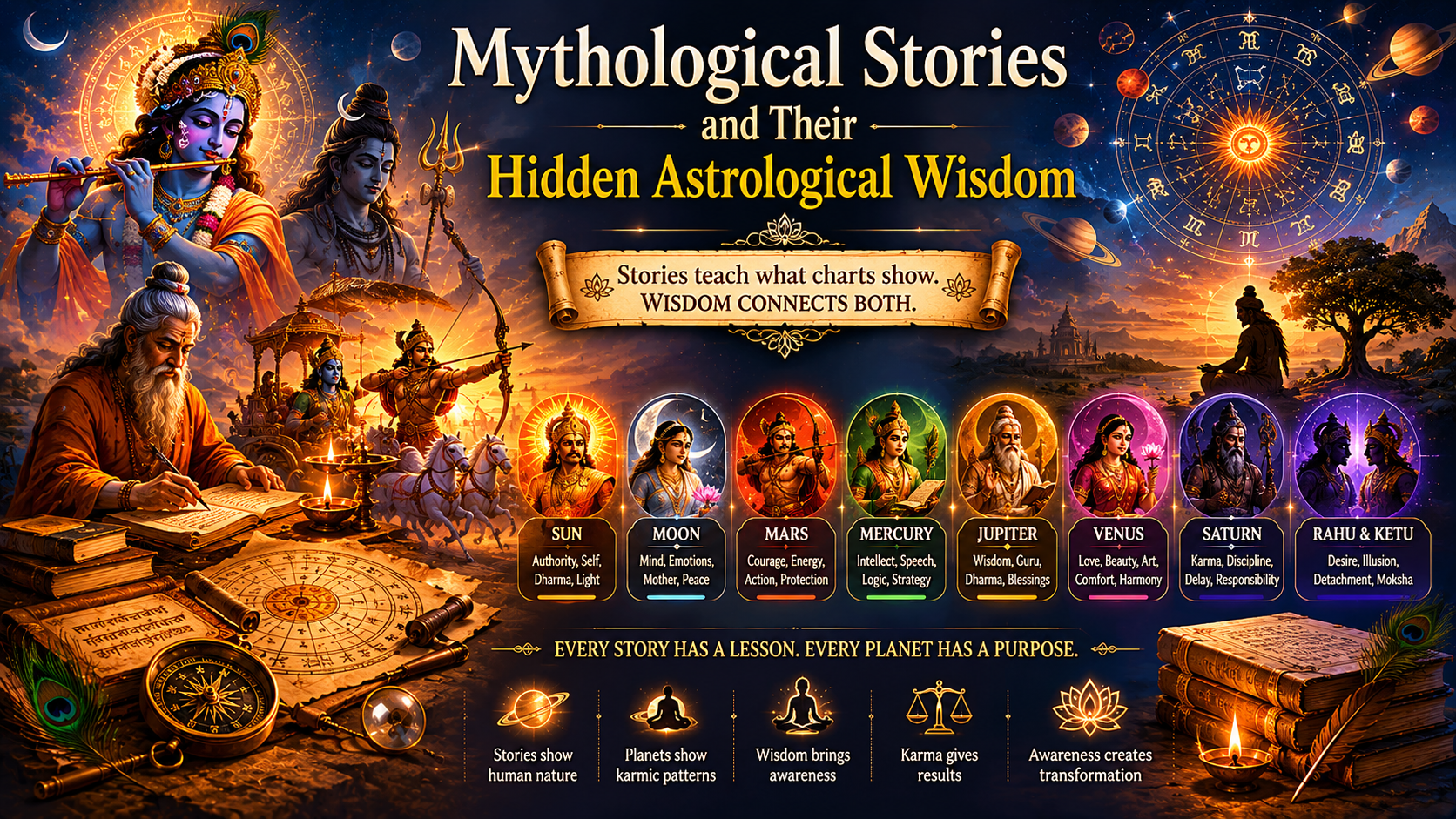
🛕 Mythological Stories and Their Hidden Astrological Wisdom
Indian mythology is not only a collection of old stories. It is a deep ocean of symbols, psychology, karma, dharma, planetary wisdom, human nature, and spiritual lessons. When we read stories from the Puranas, Ramayana, Mahabharata, and other traditional sources, we should not see them only as entertainment or religious memory. These stories carry powerful meanings about time, karma, desire, ego, duty, discipline, attachment, devotion, and destiny.
At Karmiktantra, we believe mythology and astrology are connected through wisdom. Astrology shows patterns through planets, houses, dashas, and transits. Mythological stories show the same patterns through characters, situations, choices, mistakes, blessings, curses, vows, battles, and inner transformation.
A birth chart may show Saturn’s lesson of discipline, but a story can make us feel what discipline means. A chart may show Rahu’s illusion, but a story can show how desire traps the mind. A chart may show Mars energy, but a story can show the difference between courage and aggression. A chart may show Venus, but mythology can explain love, beauty, attachment, devotion, and temptation in a living way.
This is why mythological stories are not separate from astrology. They are mirrors of karmic truth.
🌌 Mythology as Symbolic Knowledge
Many people read mythology only literally. Some argue whether a story happened exactly in the same way or not. But deeper wisdom begins when we understand the symbolic meaning of the story.
A mythological story can work at many levels. It can be cultural memory, spiritual teaching, moral lesson, psychological mirror, karmic explanation, and cosmic symbolism at the same time.
For example, when a demon is defeated in a story, it may not only mean an outer enemy was killed. It may also mean that ignorance, ego, greed, anger, obsession, or fear was defeated within the human mind.
When a deity gives a boon, it may show the power of tapasya, devotion, discipline, and focused intention.
When a king loses his kingdom, it may represent pride, wrong judgment, bad timing, or misuse of power.
When a hero goes through exile, it may show Saturn-like testing, inner maturity, and karmic purification.
This is how mythology becomes alive. It teaches through story what astrology explains through symbols.
🪐 Planets and Mythological Archetypes
In astrology, each planet has a nature. Mythological stories help us understand that nature in a more human and emotional way.
The Sun represents authority, father, soul power, leadership, light, dignity, and ego. Mythological stories about kings, divine radiance, truth, and responsibility often carry Sun-like lessons.
The Moon represents mind, mother, emotion, memory, sensitivity, and comfort. Stories involving emotional attachment, motherly protection, devotion, and mental instability often reflect Moon-like wisdom.
Mars represents courage, war, protection, aggression, physical strength, and action. Stories of warriors, battles, weapons, and heroic action often show Mars energy.
Mercury represents intelligence, speech, strategy, wit, learning, and communication. Stories involving cleverness, diplomacy, debate, and calculated decisions reflect Mercury.
Jupiter represents guru, dharma, wisdom, children, blessings, spiritual knowledge, and ethics. Stories of sages, teachers, divine counsel, and moral guidance carry Jupiter’s light.
Venus represents love, beauty, comfort, art, desire, marriage, attraction, and pleasure. Stories of love, devotion, temptation, luxury, and artistic beauty often show Venus-related lessons.
Saturn represents karma, discipline, delay, suffering, service, humility, time, and justice. Stories of exile, hardship, labor, poverty, patience, and karmic testing carry Saturn’s message.
Rahu represents obsession, ambition, illusion, deception, foreignness, sudden rise, and hunger. Stories of uncontrolled desire, disguise, manipulation, and shadowy ambition often reveal Rahu.
Ketu represents detachment, renunciation, moksha, separation, past-life knowledge, and spiritual depth. Stories of sages, sacrifice, isolation, and inner freedom often carry Ketu-like wisdom.
When we understand this, every story becomes a living astrology lesson.
🔥 Rahu and the Lesson of Uncontrolled Desire
One of the most powerful mythological symbols related to Rahu is the story of desire that refuses limits. Rahu represents hunger. It wants more. More power, more recognition, more experience, more pleasure, more status, more control.
In life, Rahu becomes active when a person feels, “If I get this one thing, everything will be complete.” But after getting it, another desire appears. Then another. Then another.
This is the trap of Rahu.
Mythological stories often show characters who receive boons through tapasya but misuse them because desire is not purified. They gain power, but not wisdom. They receive strength, but not humility. They reach high position, but their inner hunger remains uncontrolled.
This is exactly how Rahu works in a birth chart. Rahu can give success, fame, foreign connection, technology, mass influence, and bold ambition. But without wisdom, Rahu creates obsession, illusion, addiction, comparison, and dissatisfaction.
The hidden lesson is simple: ambition is useful only when guided by dharma.
⏳ Saturn and the Wisdom of Exile, Delay and Duty
Many mythological stories include exile, hardship, waiting, struggle, or long periods of testing. These are deeply Saturn-like themes.
Saturn does not usually give quick comfort. Saturn teaches through time. It asks a person to become mature, responsible, patient, humble, and disciplined. When Saturn is active, shortcuts fail. Ego breaks. Reality becomes unavoidable.
In stories, when a noble character goes through exile or hardship, the outer situation may look like suffering. But inwardly, it becomes training. The person becomes stronger, wiser, calmer, and more aligned with dharma.
This is the real meaning of Saturn. Saturn is not only pain. Saturn is preparation. Saturn is the strict teacher who removes weakness from the foundation.
In astrology, a strong Saturn period may feel heavy, but it can build permanent success if the person accepts discipline. Mythology teaches the same truth through story: the one who survives time with dignity becomes powerful.
🧭 Krishna’s Wisdom and Mercury-Jupiter Balance
In the Mahabharata, Krishna’s role is not only divine. It is also a deep lesson in intelligence, timing, dharma, strategy, and guidance. Krishna does not always solve things by force. He uses wisdom, speech, timing, diplomacy, and deeper understanding of karma.
This reflects a powerful balance of Mercury and Jupiter.
Mercury gives strategy, communication, flexibility, and intelligent response. Jupiter gives dharma, ethics, wisdom, and higher guidance. When both work together, a person does not act blindly. They know when to speak, when to stay silent, when to negotiate, when to fight, and when to step back.
This is extremely important in astrology. A person may have Mars strength, but without Mercury and Jupiter, courage can become aggression. A person may have intelligence, but without dharma, intelligence can become manipulation.
Krishna’s wisdom teaches that real power is not only strength. Real power is right action at the right time for the right purpose.
🏹 Arjuna and the Inner Battle of the Mind
Arjuna’s confusion on the battlefield is one of the greatest psychological moments in Indian tradition. He is a warrior, but his mind becomes shaken. He knows his duty, but emotion overpowers him. He has skill, but his inner clarity collapses.
This is not just a war story. It is a human story.
Every person faces such a battlefield at some point. Career decisions, family duties, relationship choices, moral conflict, fear of failure, emotional attachment, and responsibility can create inner confusion.
In astrology, this can be seen through the Moon, Mars, Mercury, Jupiter, and the 10th house of karma. The Moon shows emotional state. Mars shows courage. Mercury shows thinking. Jupiter shows wisdom. The 10th house shows duty and action in the world.
Arjuna’s lesson is that emotion must be guided by wisdom. Duty must be understood clearly. Action must not come from ego, fear, or attachment, but from dharma.
This is the heart of karma-based astrology too.
🌸 Venus: Love, Beauty and Attachment in Stories
Mythological stories often show love in many forms: devotion, attraction, loyalty, sacrifice, temptation, beauty, and attachment. These themes are connected with Venus.
Venus is not only romance. It is also refinement, pleasure, art, luxury, relationship, harmony, and devotion. But Venus can become problematic when love becomes attachment, beauty becomes vanity, comfort becomes laziness, and desire becomes indulgence.
Stories of love and separation often teach that love must be balanced with dharma. Attraction without responsibility creates pain. Pleasure without self-control creates weakness. Beauty without wisdom becomes illusion.
In a birth chart, Venus can give charm, creativity, relationship happiness, luxury, and artistic ability. But if imbalanced, it can create dependency, overspending, relationship confusion, and emotional weakness.
Mythology teaches Venus through stories of devotion, loyalty, temptation, and sacrifice.
🔥 Mars: Courage vs Anger
Mars is the warrior energy. It is needed for protection, action, courage, and survival. Without Mars, a person may lack strength to fight injustice or defend their path.
But uncontrolled Mars becomes anger, violence, harsh speech, impatience, and conflict. Mythological battles often show this difference.
A true warrior does not fight out of ego. A true warrior fights for dharma. This is the higher Mars.
When Mars is guided by dharma, it becomes courage. When Mars is guided by ego, it becomes destruction.
This is an important lesson for people with strong Mars in their chart. They must learn discipline, controlled action, and noble courage. Otherwise, the same strength can harm relationships, career, and peace.
🪔 Mythology Teaches Astrology Through Living Examples
Astrology can sometimes feel technical. Houses, signs, aspects, dashas, yogas, and transits may be difficult for a beginner. But mythology makes these principles easier to understand.
If someone wants to understand Saturn, they should study stories of patience, exile, hardship, duty, and time.
If someone wants to understand Rahu, they should study stories of illusion, ambition, disguise, and uncontrolled desire.
If someone wants to understand Jupiter, they should study the role of guru, wisdom, dharma, and blessings.
If someone wants to understand Mars, they should study warriors, battles, courage, and anger.
If someone wants to understand Venus, they should study love, beauty, devotion, and attachment.
Stories turn planetary principles into human experience.
📖 Karmiktantra’s View on Mythology and Astrology
At Karmiktantra, we do not use mythology to create blind belief. We use it to explain deeper wisdom. A story should not make a person superstitious. It should make the person more aware.
Mythological stories are powerful because they speak to the mind through images, emotions, and characters. They teach us that karma has consequences, pride has a fall, discipline has reward, devotion has strength, desire needs control, and wisdom must guide action.
Astrology shows the pattern in the chart.
Mythology shows the pattern in story.
Life shows the pattern through experience.
When all three are understood together, a seeker gains clarity.
✨ Final Thought
Mythological stories are not old stories lying in the past. They are living mirrors of human nature. They show the same forces that astrology studies: karma, desire, discipline, wisdom, love, anger, detachment, timing, and dharma.
Every planet has a story.
Every story has a lesson.
Every lesson has a karmic meaning.
When mythology is read with awareness, it becomes astrology in story form. It helps us understand not only the planets in the sky, but the planets working inside our own mind.
At Karmiktantra, we believe true knowledge begins when stories stop being only stories and start becoming mirrors.
Because mythology does not just tell us what happened.
It shows us what happens again and again inside human life.